Lesson 2 of 4 in Module 1
An ETF has two markets: the secondary market, where investors buy and sell shares on an exchange, and the primary market, where authorized participants create and redeem shares with the fund. Lesson 1 introduced these two markets. This lesson looks at what happens in each one, and at why an ordinary trade on the exchange is not the same thing as creating or redeeming shares with the fund.
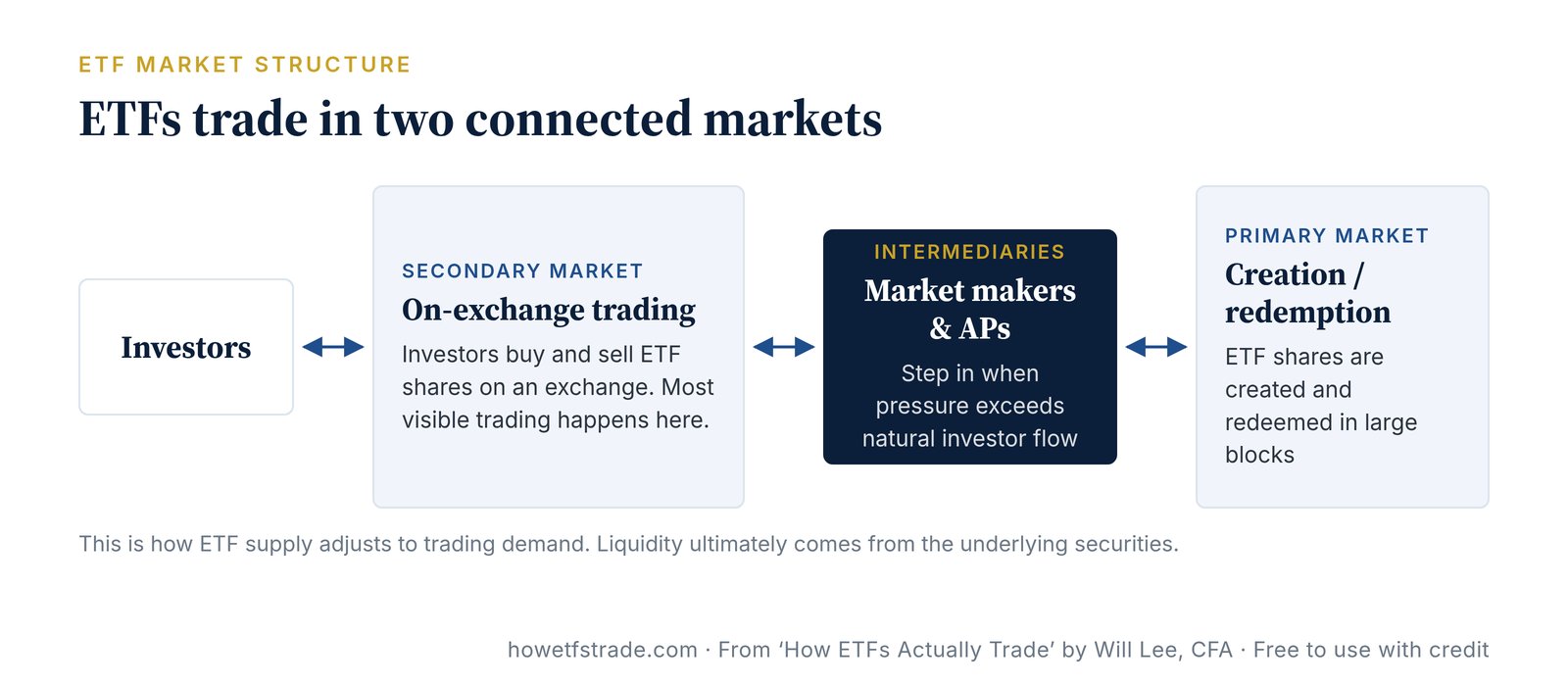
The secondary market is where investors buy and sell ETF shares on an exchange. Most visible trading activity occurs there. When you buy or sell an ETF share on the exchange, you are usually trading with another investor or a market maker, not with the fund itself. The fund's holdings do not have to be bought or sold for that trade to happen. Investors trading on an exchange can buy or sell any number of shares. Those trades do not, by themselves, change the number of shares outstanding.
The primary market is where ETF shares are created and redeemed in large blocks, between the fund and its authorized participants. Ordinary investors do not transact in that market. The share count changes when authorized participants create or redeem shares with the fund in the primary market. This is how ETF supply adjusts in response to trading demand.
The two markets are connected. Market makers provide liquidity in the secondary market and hedge their exposure using the underlying securities. Authorized participants transact directly with the ETF sponsor to create or redeem shares when imbalances arise. The same firm can play both roles, but the roles are different. How those two markets connect decides the bid-ask spread you pay, how closely the price tracks net asset value, and how a fund behaves when markets are stressed. Liquidity ultimately comes from the underlying securities.
The next lesson looks at those three roles — the sponsor, the market maker, and the authorized participant — in more detail.
ETFs trade in two connected markets
Where a trade happens
Most exchange trades transfer existing ETF shares between investors or with a market maker. They do not, by themselves, change the number of shares outstanding or automatically trigger a creation or redemption.
Authorized participants create or redeem large blocks of shares with the fund. That is what changes the share count and connects trading on the exchange to the underlying securities.
The two markets are connected: market makers quote in the secondary market; authorized participants create and redeem in the primary market.
Secondary market and primary market, side by side
| Secondary market | Primary market | |
|---|---|---|
| What happens | Investors buy and sell ETF shares on an exchange | Authorized participants create or redeem shares with the fund |
| Who trades | Investors and market makers | Authorized participants and the fund |
| Share size | Any number of shares | Large blocks |
| Share count | Does not, by itself, change the number of shares outstanding | Creation increases it; redemption reduces it |
Glossary entries for this lesson
Check your understanding
Next: Who does what: sponsor, market maker, and authorized participant
Get the ETF trading checklist, plus course updates
A one-page checklist for reviewing an ETF's spread, underlying liquidity, and premium or discount before you trade. You'll also get a note when a new course module is published.
No spam. Unsubscribe anytime.
Disclaimer
This material is provided for informational and educational purposes only and does not constitute investment advice, a recommendation, or an offer to buy or sell any security.
All views expressed are the author’s own and do not represent the views of any employer or affiliated organization.