Short, neutral definitions of the terms used across this site’s articles, diagrams and books. Quoted passages come from the articles on this site.
- Active ETF
An exchange-traded fund whose holdings are chosen by a portfolio manager according to a stated strategy, rather than being set by rules designed to track an index.
Covered in: Active ETFs (book) · Term page →
- Arbitrage band
The range around an ETF's underlying value within which its market price can move before creating or redeeming shares becomes economical for an authorized participant. The width of the band reflects creation and redemption fees, the cost of trading the underlying securities, and hedging costs.
Covered in: How ETFs Actually Trade (book) · ETF Market Structure Explained (book) · Term page →
- Ask (offer)
The lowest price at which a seller is currently willing to sell a security. A buyer who trades immediately typically pays the ask.
Covered in: ETF trading-cost calculator · Term page →
- Assets under management (AUM)
The total market value of the assets a fund holds. "AUM reflects accumulated investor capital. It does not reflect the ETF's ability to handle incremental trades." In this sense, "AUM measures scale, not capacity."
Covered in: Why ETF Liquidity ≠ AUM · Term page →
A financial institution that has an agreement with an ETF allowing it to create and redeem the ETF's shares directly with the fund in large blocks.
From this site’s articles: "Authorized Participants can transact directly with the ETF sponsor to create or redeem shares when imbalances arise."
Covered in: Why ETF Liquidity ≠ AUM · How ETFs Actually Trade (book) · Term page →
- Average daily volume (ADV)
The average number of shares (or dollar value) of a security traded on an exchange per day over a stated period.
From this site’s articles: "Secondary market volume describes how often an ETF trades—not how much it can trade."
Covered in: Why ETF Liquidity ≠ AUM · ETF trading-cost calculator · Term page →
- Balance-sheet constraints
Limits on how much capital and inventory a dealer, market maker or authorized participant can commit at a given time, set by its own risk limits, funding and regulatory capital requirements.
Covered in: Why ETF Liquidity ≠ AUM · Why ETFs Surface Liquidity Constraints Faster Than Mutual Funds · Term page →
- Basis point (bp, bps)
One hundredth of one percent (0.01%). 100 basis points equal 1%. Trading costs, spreads and premiums or discounts are often quoted in basis points.
Covered in: ETF trading-cost calculator · Term page →
- Bid
The highest price at which a buyer is currently willing to buy a security. A seller who trades immediately typically receives the bid.
Covered in: ETF trading-cost calculator · Term page →
- Bid-ask spread
The difference between the ask and the bid, often expressed in basis points of the midpoint price. It is part of the cost of trading immediately.
From this site’s articles: "During periods of market volatility, ETF bid–ask spreads often widen."
Covered in: ETF trading-cost calculator · Why ETF Liquidity ≠ AUM · Why ETFs Surface Liquidity Constraints Faster Than Mutual Funds · Term page →
- Capacity
The amount a fund or strategy can trade, or the assets it can manage, before trading costs and market impact rise materially.
From this site’s articles: "Liquidity reflects marginal capacity under current conditions."
Covered in: Active ETFs (book) · Why ETFs Surface Liquidity Constraints Faster Than Mutual Funds · Term page →
- Cash creation and redemption
A creation or redemption in which the authorized participant delivers or receives cash instead of securities, and the fund itself buys or sells the underlying securities.
Covered in: ETF Market Structure Explained (book) · How ETFs Actually Trade (book) · Term page →
- Creation and redemption
The primary-market process through which authorized participants increase the number of ETF shares outstanding (creation) or reduce it (redemption) by exchanging baskets of securities or cash with the fund.
From this site’s articles: "This is how ETF supply adjusts in response to trading demand."
Covered in: Why ETF Liquidity ≠ AUM · ETF Market Structure Explained (book) · Free ETF diagrams · Term page →
- Creation basket (basket)
The list of securities and/or cash, published by the fund each day, that an authorized participant delivers to the fund to create ETF shares, or receives from the fund when it redeems them.
Covered in: How ETFs Actually Trade (book) · ETF Market Structure Explained (book) · Term page →
- Creation unit
The fixed, large block of ETF shares, set by the fund, in which shares are created or redeemed with authorized participants. Investors trading on an exchange can buy or sell any number of shares; creation units apply only to the primary market.
Covered in: ETF Market Structure Explained (book) · How ETFs Actually Trade (book) · Term page →
- Custom basket
A creation or redemption basket that differs from a pro rata slice of the fund's portfolio, used where the fund's policies and applicable rules permit it.
Covered in: How ETFs Actually Trade (book) · Active ETFs (book) · Term page →
- Dilution (fund flows)
The transfer of trading costs caused by investors entering or leaving a fund to the investors who remain in it.
From this site’s articles, on mutual funds under stress: "Dilution effects may be spread across remaining shareholders."
Covered in: Why ETFs Surface Liquidity Constraints Faster Than Mutual Funds · Term page →
- ETF liquidity
"ETF liquidity is not primarily determined by AUM. It is determined by market structure, specifically how ETFs connect secondary market trading with the liquidity of their underlying securities."
Covered in: Why ETF Liquidity ≠ AUM · Free ETF diagrams · Term page →
- ETF sponsor (issuer)
The firm that establishes and manages an ETF, sets its creation and redemption terms, and publishes its holdings or basket.
Covered in: Why ETF Liquidity ≠ AUM · Term page →
- Exchange-traded fund (ETF)
A pooled investment fund whose shares trade on a stock exchange throughout the day and whose share count can change through creation and redemption.
From this site’s articles: "ETFs are not operating companies. They are investment vehicles that hold baskets of underlying securities."
Covered in: Why ETF Liquidity ≠ AUM · ETF Market Structure Explained (book) · Term page →
- Expense ratio
A fund's annual operating expenses expressed as a percentage of its average net assets. It is deducted from fund assets over time rather than charged per trade.
Covered in: ETF trading-cost calculator · Term page →
- Hedging
Taking an offsetting position to reduce exposure to price moves.
From this site’s articles: "Market makers provide liquidity in the secondary market and hedge their exposure using the underlying securities."
Covered in: Why ETF Liquidity ≠ AUM · Why ETFs Surface Liquidity Constraints Faster Than Mutual Funds · Term page →
- In-kind transfer
A creation or redemption settled by exchanging securities rather than cash: the authorized participant delivers the basket to create shares and receives securities when it redeems them.
Covered in: ETF Market Structure Explained (book) · How ETFs Actually Trade (book) · Term page →
An estimate of an ETF's per-share value calculated and published at regular intervals during the trading day, based on the fund's disclosed holdings or basket. Also called the indicative optimized portfolio value (IOPV).
Covered in: How ETFs Actually Trade (book) · ETF Market Structure Explained (book) · Term page →
- Limit order
An order to buy or sell at a specified price or better. It controls the execution price but does not guarantee that the order will be filled.
Covered in: ETF trading-cost calculator · Term page →
- Market impact
The change in a security's price caused by executing a trade, typically larger for bigger orders relative to available liquidity.
Covered in: Active ETFs (book) · ETF trading-cost calculator · Term page →
- Market maker
"Market makers provide liquidity in the secondary market and hedge their exposure using the underlying securities." They "provide continuous two-sided quotes" and "adjust spreads to reflect hedging difficulty."
Covered in: Why ETF Liquidity ≠ AUM · Why ETFs Surface Liquidity Constraints Faster Than Mutual Funds · Term page →
- Market order
An order to buy or sell immediately at the best available price. It prioritizes execution over price.
Covered in: ETF trading-cost calculator · Term page →
- Midpoint (mid price)
The average of the bid and the ask: (bid + ask) ÷ 2. Spreads and half-spread costs are commonly measured relative to it.
Covered in: ETF trading-cost calculator · Term page →
- Mutual fund
A pooled investment fund whose shares are bought from and sold back to the fund itself rather than traded on an exchange.
From this site’s articles: "Mutual funds transact at net asset value once per day. Subscriptions and redemptions are processed after markets close."
Covered in: Why ETFs Surface Liquidity Constraints Faster Than Mutual Funds · Term page →
The value of a fund's assets minus its liabilities, divided by the number of shares outstanding. Funds typically calculate it once per business day after the market close.
Covered in: Why ETFs Surface Liquidity Constraints Faster Than Mutual Funds · How ETFs Actually Trade (book) · Term page →
The difference between an ETF's market price and its NAV (or intraday indicative value), usually expressed as a percentage or in basis points. A price above NAV is a premium; a price below NAV is a discount.
Covered in: ETF trading-cost calculator · Why ETFs Surface Liquidity Constraints Faster Than Mutual Funds · Term page →
- Price discovery
The process by which trading among buyers and sellers sets a market price that reflects available information.
From this site’s articles: "ETFs are compressing price discovery into the present. Mutual funds are distributing it across time."
Covered in: Why ETFs Surface Liquidity Constraints Faster Than Mutual Funds · Term page →
- Primary market
For ETFs, the market "where ETF shares are created and redeemed in large blocks," between the fund and its authorized participants.
Covered in: Why ETF Liquidity ≠ AUM · Free ETF diagrams · Term page →
- Round-trip cost
The total cost of buying and later selling a position, including both half-spreads, any change in premium or discount between entry and exit, and commissions.
Covered in: ETF trading-cost calculator · Term page →
- Secondary market
For ETFs, the market "where investors buy and sell ETF shares on an exchange." "Most visible trading activity occurs in the secondary market."
Covered in: Why ETF Liquidity ≠ AUM · Free ETF diagrams · Term page →
- Underlying liquidity
The liquidity of the securities an ETF holds. "ETF liquidity ultimately comes from the liquidity of the underlying securities, not from the number of ETF shares already outstanding."
Covered in: Why ETF Liquidity ≠ AUM · Free ETF diagrams · Term page →
Get the ETF Liquidity Cheat Sheet
Subscribe to receive a free two-page ETF Liquidity Cheat Sheet, plus an occasional email when a new explainer is published.
No spam. Unsubscribe anytime.
Go deeper: books by Will Lee, CFA
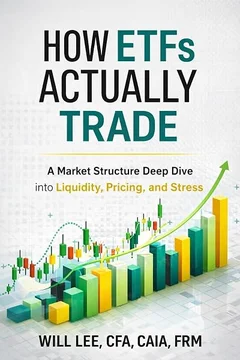
For traders, PMs, and ETF specialists: a practitioner's deep dive into APs, market makers, NAV vs. iNAV, and trading under stress.
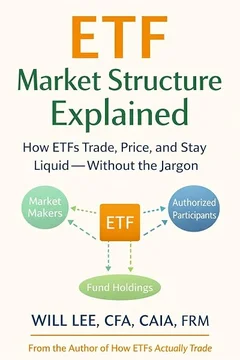
For advisors, investors, and new team members: a jargon-light foundation in creation/redemption, intraday value, and common liquidity myths.
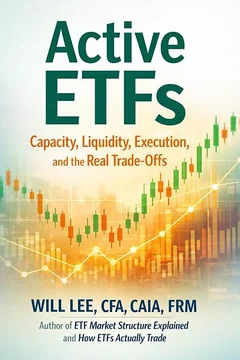
For ETF product managers, issuers, capital markets teams, and allocators: capacity, execution costs, and liquidity trade-offs when active strategies run in an ETF.
Disclaimer
This material is provided for informational and educational purposes only and does not constitute investment advice, a recommendation, or an offer to buy or sell any security.
All views expressed are the author’s own and do not represent the views of any employer or affiliated organization.