Why ETFs Surface Liquidity Constraints Faster Than Mutual Funds
When markets become volatile, exchange-traded funds (ETFs) often appear to show stress before mutual funds. Prices move quickly, bid–ask spreads widen, and discounts or premiums to net asset value can emerge. This behavior is frequently interpreted as a flaw in the ETF structure—evidence that ETFs are fragile or that their liquidity is unreliable under pressure.
That interpretation misses the point.
ETFs are not creating liquidity problems. They are revealing them earlier and more transparently than other fund structures.
Understanding why requires looking at how ETFs and mutual funds process liquidity stress differently—not at the level of assets under management, but at the level of market structure.
How Mutual Funds Absorb Liquidity Stress Invisibly
Mutual funds transact at net asset value once per day. Subscriptions and redemptions are processed after markets close, using prices that reflect completed trades rather than real-time conditions.
This structure allows mutual funds to delay the recognition of liquidity costs.
When markets are stressed:
- Redemption activity accumulates during the day
- Portfolio managers meet those flows over time
- Transaction costs are absorbed gradually
- Dilution effects may be spread across remaining shareholders
From the outside, the fund appears stable. NAV changes may look orderly. But the liquidity cost has not disappeared—it has simply been deferred and smoothed.
The key point is not that mutual funds avoid liquidity stress, but that their structure allows that stress to remain largely invisible until it has already been internalized.
How ETFs Transmit Liquidity Stress in Real Time
ETFs operate differently. They trade continuously on exchanges, and their prices are set by market participants who must manage risk in real time.
Market makers quoting ETF prices must consider:
- Current volatility
- The liquidity of the underlying securities
- The cost of hedging intraday exposure
- The expected economics of creating or redeeming shares
As conditions change, those expectations change immediately—and are reflected in ETF prices and spreads.
This means ETF pricing is forward-looking. It incorporates not only what liquidity looks like now, but what it is expected to look like if trading demand continues.
Mutual fund NAVs, by contrast, are backward-looking. They reflect executed trades, not the marginal cost of the next one.

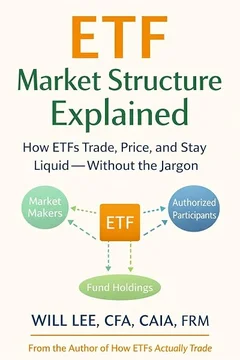
The Role of Market Makers and Authorized Participants
The same intermediaries that enable ETF liquidity in normal markets are also responsible for surfacing liquidity constraints during stress.
Market makers:
- Provide continuous two-sided quotes
- Adjust spreads to reflect hedging difficulty
- Price in balance-sheet and volatility risk
Authorized participants (APs):
- Decide when creation and redemption activity is economical
- Evaluate funding conditions and operational constraints
- Step back when underlying markets become costly or uncertain to access
When these intermediaries face higher risk or higher costs, they do not hide it. They embed those conditions directly into ETF pricing.
This is not a failure of the ETF structure—it is the structure functioning as designed.
Why ETFs Often Look “Worse” During Market Stress
Because ETFs transmit liquidity information immediately, they often appear to behave worse than mutual funds during volatile periods.
Prices move first. Spreads widen visibly. Discounts or premiums attract attention.
This difference is often mistaken for fragility, when it is actually transparency.
But this comparison is misleading.
ETFs are compressing price discovery into the present. Mutual funds are distributing it across time.
The apparent calm of mutual fund NAVs during stress is not evidence of superior liquidity. It is evidence of delayed recognition.
In this sense, ETF prices are closer to a live market signal, while mutual fund NAVs are closer to an accounting result.
What This Means for Investors and Allocators
For professionals evaluating fund behavior during stress, several implications follow:
- Widening ETF spreads are information, not malfunction
- ETF prices can serve as early indicators of underlying market stress
- Comparing ETF volatility to mutual fund stability is structurally flawed
- Liquidity risk should be assessed at the underlying asset level, not the wrapper
Most importantly, visible stress is not the same as structural weakness. Transparency can be uncomfortable, but it is often more honest.
Relationship to ETF Liquidity and AUM
The same market-structure mechanics that decouple ETF liquidity from assets under management also explain why ETFs surface liquidity constraints faster than mutual funds.
AUM reflects accumulated capital.
Liquidity reflects marginal capacity under current conditions.
When markets are calm, this distinction is easy to ignore. When markets are stressed, it becomes unavoidable.
The Core Takeaway
ETFs do not fail under stress—they reflect it.
Their intraday pricing and visible spreads make liquidity costs explicit rather than implicit. That transparency can look unsettling, but it provides a clearer picture of market conditions than structures that delay or smooth the same information.
Free: get these diagrams as a two-page ETF Liquidity Cheat Sheet ↓ or download the PDF, no signup
This explanation builds on the same market-structure framework used throughout How ETFs Trade.