For traders, PMs, and ETF specialists: a practitioner's deep dive into APs, market makers, NAV vs. iNAV, and trading under stress.
Kindle edition on Amazon. All books by Will Lee on Amazon →
From the book description
ETF liquidity is widely misunderstood. Trading volume is mistaken for depth. Discounts are treated as failures. Arbitrage is assumed to be automatic.
In reality, none of this is true.
How ETFs Actually Trade is a market structure deep dive that explains how exchange-traded funds really function in modern financial markets. Written for traders, portfolio managers, ETF professionals, regulators, and advanced investors, this book breaks down ETF trading mechanics, liquidity dynamics, price discovery, and arbitrage behavior with clarity and precision.
Rather than presenting ETFs as simple investment products, the book explains them as interfaces between multiple liquidity regimes—secondary market trading, primary market creation and redemption, dealer balance sheets, and often illiquid underlying assets. This framework explains why ETF volume does not equal liquidity, why bid-ask spreads widen during volatility, and why ETF prices can diverge from NAV without market failure.
Key topics include:
- ETF market structure and trading mechanics
- Primary vs secondary market liquidity
- Creation and redemption processes explained clearly
- The real role of Authorized Participants (APs) and market makers
- Why ETF liquidity is conditional, not guaranteed
- NAV vs iNAV vs market price
- ETF arbitrage, arbitrage bands, and pricing breakdowns
- Why ETF discounts and premiums persist
- Intraday ETF pricing and price discovery
- ETF behavior during market stress and volatility
- Why ETFs often trade when underlying markets freeze
- Common regulatory misunderstandings of ETFs
- ETF execution strategy for institutional investors
Using anonymized real-world market dynamics, the book explains what actually happens during periods of stress—without hype, fear-mongering, or product marketing. It shows that ETFs do not create liquidity or systemic risk. They reveal where liquidity resides, when it disappears, and what it truly costs.
This is not a guide to selecting ETFs or building a portfolio. It is a professional reference on how ETFs trade, how prices are formed, and how liquidity behaves when constraints bind. For readers seeking a rigorous, practitioner-level understanding of ETF trading, pricing, and market structure, How ETFs Actually Trade provides the missing framework.
Also by Will Lee
ETF Market Structure Explained provides a clear, foundational introduction to how ETFs function within modern markets. Readers looking for a more accessible overview before diving deeper may find it a helpful companion to this book.
Book description as published on the book’s Amazon page.
Related glossary terms
- Arbitrage band
- Assets under management (AUM)
- Authorized participant (AP)
- Average daily volume (ADV)
- Balance-sheet constraints
- Bid-ask spread
- Creation basket (basket)
- Custom basket
- Dilution (fund flows)
- ETF liquidity
- ETF sponsor (issuer)
- Hedging
- Intraday indicative value (iNAV, IOPV)
- Market maker
- Mutual fund
- Net asset value (NAV)
- Premium / discount
- Price discovery
- Primary market
- Secondary market
- Underlying liquidity
Get the ETF Liquidity Cheat Sheet
Subscribe to receive a free two-page ETF Liquidity Cheat Sheet, plus an occasional email when a new explainer is published.
No spam. Unsubscribe anytime.
More books by Will Lee, CFA
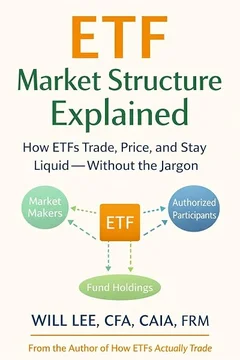
For advisors, investors, and new team members: a jargon-light foundation in creation/redemption, intraday value, and common liquidity myths.
For ETF product managers, issuers, capital markets teams, and allocators: capacity, execution costs, and liquidity trade-offs when active strategies run in an ETF.
Disclaimer
This material is provided for informational and educational purposes only and does not constitute investment advice, a recommendation, or an offer to buy or sell any security.
All views expressed are the author’s own and do not represent the views of any employer or affiliated organization.