A semi-transparent ETF is an exchange-traded fund, typically an active fund, that does not disclose its complete holdings every business day. It may instead publish a proxy portfolio, a delayed holdings list, or another partial view, so market makers can hedge without the manager broadcasting every position.
Covered in: Active ETFs (book)
Common questions
- What is the difference between a fully transparent and a semi-transparent ETF?
- A fully transparent ETF discloses its complete portfolio, typically each business day, so authorized participants and market makers can hedge and arbitrage against the actual holdings. A semi-transparent ETF does not publish that full daily list. It may show a proxy portfolio that approximates the strategy, a delayed holdings file, or a custom creation basket that is close enough to hedge. The trade-off is the same one on the portfolio transparency page: more disclosure can tighten spreads; less disclosure can better protect the manager's edge, and market makers may need wider quotes. See also: Portfolio transparency · Custom basket · Active ETF.
- How do market makers hedge a semi-transparent ETF?
- Because they do not see the full book in real time, market makers typically hedge with a published proxy portfolio, a delayed holdings list, and indicative-value tools in the same family as iNAV—including a verified indicative intraday value (VIIV) where one is provided. Those figures are estimates, not the official NAV. When the proxy or the indicative value is only an approximation of the true portfolio, the hedge is less precise, so quotes and the arbitrage band are often wider than for a fully transparent fund. See also: Intraday indicative value (iNAV, IOPV) · Portfolio transparency.
- Are semi-transparent ETFs the same as non-transparent ETFs?
- The two labels are often used interchangeably for ETFs that do not disclose full holdings every day. In practice, "semi-transparent" usually means some information is still published—a proxy portfolio, a delayed list, or an indicative value—while "non-transparent" is sometimes used more loosely for the same structures. Neither is a fully transparent, daily-holdings ETF. The useful distinction is how much is disclosed, how often, and what market makers can hedge with, not the marketing name. See also: Portfolio transparency · Active ETF · Active ETFs (book).
Related terms
Go deeper: books by Will Lee, CFA
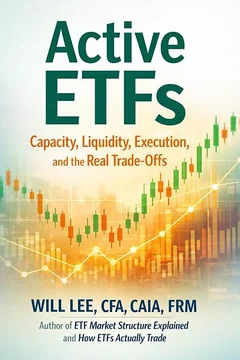
For ETF product managers, issuers, capital markets teams, and allocators: capacity, execution costs, and liquidity trade-offs when active strategies run in an ETF.
Get the ETF trading checklist, plus course updates
A one-page checklist for reviewing an ETF's spread, underlying liquidity, and premium or discount before you trade. You'll also get a note when a new course module is published.
No spam. Unsubscribe anytime.
Disclaimer
This material is provided for informational and educational purposes only and does not constitute investment advice, a recommendation, or an offer to buy or sell any security.
All views expressed are the author’s own and do not represent the views of any employer or affiliated organization.