A thematic ETF is an exchange-traded fund that concentrates its holdings on a theme, trend, or idea—such as clean energy or cybersecurity—rather than on a broad market or a traditional sector index. Its shares trade on an exchange throughout the day, but spreads, premiums, and the ease of creating or redeeming shares still depend on the liquidity of that often narrower basket.
How it trades
Like other ETFs, a thematic ETF has two liquidity layers. Investors buy and sell shares on the exchange at the bid and the ask, while authorized participants can create or redeem larger blocks with the fund, usually by delivering or receiving a basket of the theme's holdings, and sometimes with a cash balancing amount. Tradable liquidity still comes from those underlying securities. A theme that is concentrated in a few names, that leans on smaller or less frequently traded stocks, or that spans markets in different time zones can be harder and more expensive to hedge or to assemble as a basket, even when the ETF itself shows a modest volume.
That is why the share-price spread can be wider than on a broad-market ETF, and why the market price can move farther from official value when some of the underlyings are closed, thin, or moving at once. Index-tracking thematic funds may also reconstitute when the theme's rules add or drop names, which can concentrate trading in less liquid holdings. None of this means the shares cannot be traded; it means the cost of trading follows the basket, not just the ETF's own volume. See also: Underlying liquidity · Liquidity dispersion · Creation and redemption · Bid-ask spread.
Key points
- A thematic ETF is built around a theme or trend, not a broad market or a traditional sector index.
- The basket can be more concentrated, and a few names can drive both performance and trading costs.
- Some thematic ETFs track a rules-based or custom theme index; others are actively managed.
- Spreads, premiums, and creation or redemption still follow the liquidity of the underlying holdings.
- A narrow theme can run into capacity limits if flows become large relative to how easily those holdings trade.
Common questions
- How is a thematic ETF different from a broad-market or sector ETF?
- A broad-market ETF is built to represent a wide universe of stocks or bonds. A traditional sector ETF is built around an established industry classification, such as financials or health care. A thematic ETF is built around an idea or trend that can cut across sectors and countries, using a rules-based or custom index, or an active manager's selection, to decide what belongs in the theme. That can leave the fund more concentrated than a broad-market portfolio, and two thematic funds on similar ideas can still hold different names if their rules differ. The theme is a design choice, not a measure of how easily the shares or the underlyings trade. See also: Exchange-traded fund (ETF) · Active ETF.
- Where does a thematic ETF's liquidity come from when I trade the shares?
- From the same two markets as other ETFs. On the exchange, you trade shares with other investors and with market makers at the quoted bid and ask. Behind those quotes, market makers and authorized participants hedge and, when needed, create or redeem shares using the theme's underlying securities, or cash when a name is hard to deliver. If those holdings are concentrated, less frequently traded, or listed in markets that are closed during U.S. hours, hedging is harder and the spread, or the gap between the share price and official value, can widen. The ETF's own volume does not, by itself, tell you how much can be traded without moving the basket. See also: Underlying liquidity · Liquidity dispersion · Bid-ask spread · Creation and redemption.
- Why can a thematic ETF be more concentrated, and how can that affect trading costs?
- A theme is usually narrower than a broad market, so a few stocks—or a cluster of related stocks—can make up a large share of the fund. When an authorized participant creates or redeems shares, or when a market maker hedges, those larger weights have to be traded, and the cost shows up in the basket, in the spread, and sometimes in a short-lived premium or discount. If inflows become large relative to how easily those names trade, the strategy can also run into capacity limits: incremental creates start to move the underlyings more, and the fund's own trading can start to work against the theme. The effect varies with the holdings and with market conditions; it is a consequence of a narrower basket, not a reason the shares cannot be traded. See also: Capacity · Liquidity dispersion · Market impact.
Related terms
Go deeper: books by Will Lee, CFA
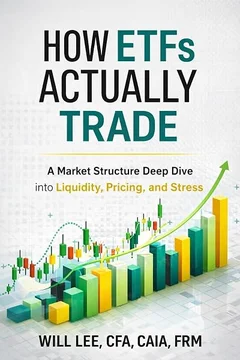
For traders, PMs, and ETF specialists: a practitioner's deep dive into APs, market makers, NAV vs. iNAV, and trading under stress.
Get the ETF trading checklist, plus course updates
A one-page checklist for reviewing an ETF's spread, underlying liquidity, and premium or discount before you trade. You'll also get a note when a new course module is published.
No spam. Unsubscribe anytime.
Disclaimer
This material is provided for informational and educational purposes only and does not constitute investment advice, a recommendation, or an offer to buy or sell any security.
All views expressed are the author’s own and do not represent the views of any employer or affiliated organization.