ETF tax efficiency is the tendency of many exchange-traded funds to distribute fewer capital gains than comparable mutual funds, because they can redeem shares by delivering portfolio securities in kind rather than selling those securities for cash. That difference can matter in a taxable account; it does not change the tax character of the fund's ordinary income, and it is not relevant in a tax-advantaged account such as an IRA or a 401(k).
Covered in: ETF Market Structure Explained (book)
Common questions
- Why can in-kind redemptions keep an ETF's capital-gains distributions low?
- When an authorized participant redeems ETF shares in kind, the fund delivers a basket of portfolio securities instead of selling those securities for cash. If the fund sells an appreciated holding, it realizes a capital gain. The law requires mutual funds and ETFs to distribute net capital gains on the sale of portfolio securities to shareholders, who generally report them as long-term capital gains, even if they did not sell their shares. Under section 852(b)(6) of the tax code, a regulated investment company generally does not recognize gain when it distributes appreciated property to redeem its shares at the shareholder's demand, so that in-kind redemption does not, by itself, create a capital-gains distribution for remaining shareholders. The securities delivered may be a specified basket rather than a slice of every holding, and they can include appreciated positions. This is why in-kind redemptions can limit how often the fund has to sell appreciated holdings, and why capital-gains distributions from many ETFs stay low. Cash creates and redeems do not provide that same path. Illustration: a fund holds a stock that cost $40 and is now worth $100. If the fund sells the stock to raise cash for a redemption, it realizes a $60 gain, which can be included in the capital gains later distributed to remaining shareholders. If instead it delivers that $100 stock in kind to an authorized participant redeeming shares, the fund generally does not recognize the $60 of built-in gain, and that redemption does not, by itself, create a capital-gains distribution. Hypothetical figures, for arithmetic only. See also: In-kind transfer · Cash creation and redemption · ETF distributions.
- How do mutual fund redemptions differ, and do investors still pay tax when they sell their own shares?
- Investors buy mutual fund shares from the fund itself, or through an intermediary, and sell them back to the fund. Those redemptions are typically paid in cash, which can require the fund to sell portfolio securities to raise the money. If those sales realize capital gains, the gains can be included in the net capital gains the fund later distributes to remaining shareholders, who may owe tax on that distribution even if they did not sell. ETF shares, by contrast, are bought and sold by ordinary investors on an exchange. A secondary-market sale does not, by itself, require the fund to sell holdings or redeem shares. Authorized participants can still create or redeem in large blocks; when they redeem in kind, the fund can deliver securities instead of selling them. In either wrapper, this is general information, not tax advice, and selling your own shares in a taxable account is a separate event: you generally have a capital gain or loss equal to the difference between the amount you realize and your basis in the shares. A fund distribution and your own sale can both be taxable in the same year. Illustration: you hold shares and do not sell. Other investors redeem, and the mutual fund sells appreciated holdings to raise cash, realizing net capital gains of $1.00 per remaining share. If the fund distributes that $1.00, you may owe tax on it even though you did not sell. Hypothetical figures, for arithmetic only. See also: Mutual fund · Creation and redemption · In-kind transfer · ETF distributions.
- When does that tax advantage shrink or disappear?
- The in-kind advantage is not automatic, and this is general information, not tax advice. If an ETF creates and redeems in cash, the fund itself buys or sells the underlying securities, and those sales can realize capital gains that may be distributed; cash creates and redeems do not provide the same in-kind path. A taxable bond ETF's interest is generally ordinary income to shareholders regardless of the wrapper, so even when the fund can redeem in kind, the capital-gains difference may be only part of the tax picture. Leveraged and inverse ETFs typically create and redeem in cash, or with a large cash component, because they get their exposure from derivatives rather than a multiplied basket of stocks. An ETF can also realize gains when it itself sells holdings—for example, in an active strategy or when an index is reconstituted—even if shareholder redemptions are in kind. The comparison also depends on the account type: the tax efficiency of capital-gains distributions is not relevant in a tax-advantaged account such as an IRA or a 401(k). Investors in either wrapper still generally pay tax on their own sale when they sell shares in a taxable account, and treatment depends on your situation. Consult a tax professional. See also: Cash creation and redemption · Leveraged ETF · Fixed income ETF · ETF distributions · Mutual fund.
Related terms
Go deeper: books by Will Lee, CFA
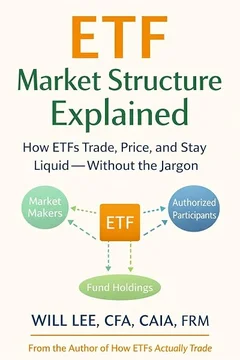
For advisors, investors, and new team members: a jargon-light foundation in creation/redemption, intraday value, and common liquidity myths.
Get the ETF trading checklist, plus course updates
A one-page checklist for reviewing an ETF's spread, underlying liquidity, and premium or discount before you trade. You'll also get a note when a new course module is published.
No spam. Unsubscribe anytime.
Disclaimer
This material is provided for informational and educational purposes only and does not constitute investment advice, a recommendation, or an offer to buy or sell any security.
All views expressed are the author’s own and do not represent the views of any employer or affiliated organization.