ETF distributions are payments a fund makes to shareholders from income or gains in the portfolio, such as bond interest, stock dividends, or realized capital gains. That income generally accrues in the fund's NAV until it is paid, and the NAV typically falls by about the distribution amount on the ex-date.
Covered in: ETF Market Structure Explained (book)
Common questions
- How do ETF distributions work, and what happens to NAV on the ex-date?
- Bond interest and stock dividends generally accrue in the fund's NAV as they are earned. The fund then pays that income, and any distributed capital gains, to shareholders on a schedule set in its prospectus—some funds pay monthly, some quarterly or on another timetable. Distributions are not guaranteed. Shareholders of record on the record date are entitled to the payment, which is delivered on the payable date. The ex-date is the first day the shares trade without the right to that distribution; if you buy on or after the ex-date, you do not receive it. When the fund pays out the distribution, its NAV decreases. For an ETF, that drop is typically visible on the ex-date, and the market price usually adjusts as well. That change is a transfer of value to eligible shareholders, not by itself a loss. Illustration: if NAV is $50.00 and the fund pays $0.20 per share, NAV falls to $49.80 on the ex-date, all else equal. Hypothetical figures, for arithmetic only. See also: Net asset value (NAV) · Fixed income ETF.
- What is the difference between 30-day SEC yield and distribution yield?
- The 30-day SEC yield, sometimes called standardized yield, is a prescribed calculation: it takes the fund's net investment income over a recent 30-day (or one-month) period, after expenses, and annualizes it as a percentage of the fund's offering price, which for most ETFs is the NAV. The method is set out in Form N-1A, and if a fund advertises a current yield it must use that method. A distribution yield is not a standardized SEC figure. Funds or data providers often annualize recent distributions and divide by NAV or market price, so the number can include special or capital-gains payouts and is not directly comparable to the 30-day SEC yield. Distributions are not the same as performance; total return and the standardized yield are the more reliable comparison tools. Illustration: a 30-day SEC yield of 4.00% and a distribution yield of 5.00% can appear on the same fund if the distribution figure includes a special or capital-gains payout. Hypothetical figures, for comparison only. See also: Net asset value (NAV) · Fixed income ETF.
- How are ETF distributions taxed?
- Tax character depends on what the fund earned, not on the ETF wrapper alone, and this is general information, not tax advice. Interest from a taxable bond ETF is generally ordinary income to shareholders. A stock ETF may pay qualified dividends, which can be taxed at the lower long-term capital-gains rates if the dividends qualify and you meet the holding-period rules. A municipal bond ETF may pay exempt-interest dividends that are generally excluded from federal taxable income, though they must still be reported and some may be subject to the alternative minimum tax. Funds may also distribute capital gains, which shareholders generally report as long-term capital gains. A distribution can also include a return of capital, which is not taxed when received but reduces your basis. In-kind redemptions can limit how often the fund has to sell appreciated holdings, which is why capital-gains distributions from many ETFs stay low; cash creates and redeems do not provide that same path. Treatment also depends on the account type—for example, a taxable brokerage account versus a retirement account—and on your situation. Consult a tax professional. See also: In-kind transfer · Cash creation and redemption · Fixed income ETF.
Related terms
Go deeper: books by Will Lee, CFA
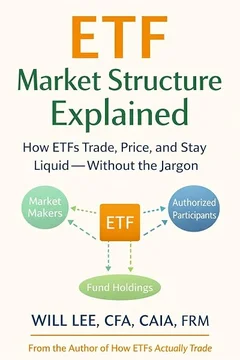
For advisors, investors, and new team members: a jargon-light foundation in creation/redemption, intraday value, and common liquidity myths.
Get the ETF trading checklist, plus course updates
A one-page checklist for reviewing an ETF's spread, underlying liquidity, and premium or discount before you trade. You'll also get a note when a new course module is published.
No spam. Unsubscribe anytime.
Disclaimer
This material is provided for informational and educational purposes only and does not constitute investment advice, a recommendation, or an offer to buy or sell any security.
All views expressed are the author’s own and do not represent the views of any employer or affiliated organization.