A money market ETF is an exchange-traded fund that is registered as a money market fund and must meet the portfolio quality, maturity, diversification, and liquidity tests in SEC Rule 2a-7. Its shares trade on an exchange throughout the day at a market price, and official NAV is typically calculated from the market value of the holdings rather than held at a stable $1.00.
How it trades
A money market ETF still trades like other ETFs: you buy and sell shares on an exchange at a bid and an ask throughout the day, and authorized participants can create or redeem larger blocks with the fund, often for cash or for short-term government securities. That is different from a traditional money market mutual fund, which investors generally buy from and sell back to the fund itself at the official net asset value calculated after the close. Official NAV on a money market ETF is typically based on the market value of the holdings, even when the fund qualifies as a government money market fund under Rule 2a-7; the live market price can still differ from that NAV. The holdings—Treasury bills and other government securities, fully collateralized repurchase agreements, and, in a prime fund, short-term corporate and bank debt—are generally very liquid, so the quoted spread is often tight, but it can widen in stress. Selling shares on the exchange is a trade with another investor, not a redemption from the fund. See also: Mutual fund · NAV vs market price · Bid-ask spread · Cash creation and redemption.
A simple NAV and market-price illustration
Hypothetical figures, for arithmetic only; not a live fund.
Suppose a money market ETF's most recent official NAV is $100.00. Midday, the bid is $99.98 and the ask is $100.02. A buyer who takes the ask pays two cents, or two basis points, above that NAV; a seller who hits the bid receives two cents below it. The gap is small in this example because the holdings are short-term and liquid, but the share still has a live market price that can differ from official NAV.
A traditional government or retail money market mutual fund is different in the way the shares are transacted: investors generally buy from and sell back to the fund at the official NAV after the close, and that NAV is often held at a stable $1.00 by using special valuation methods the rule allows for those funds. A money market ETF typically does not seek that stable $1.00 price, even when it meets the same Rule 2a-7 portfolio tests.
Key points
- Rule 2a-7 is what makes a fund a money market fund. Among other limits, a fund generally may not buy a security with remaining maturity over 397 days, must keep dollar-weighted average maturity at 60 days or less and dollar-weighted average life at 120 days or less, and must hold at least 25% of total assets in daily liquid assets and at least 50% in weekly liquid assets.
- Government money market funds invest 99.5% or more of total assets in cash, government securities, and/or repurchase agreements that are fully collateralized by cash or government securities. Prime funds may also hold short-term corporate and bank instruments, such as commercial paper and certificates of deposit, which can add credit risk. Tax-exempt, or municipal, money market funds generally invest 80% or more of assets in municipal securities.
- A Treasury, T-bill, or ultra-short bond ETF that is not registered as a money market fund is not subject to Rule 2a-7, even if it holds similar short-term securities and is used as a cash sleeve. The prospectus states whether the fund is a money market fund.
- Money market funds report a prescribed 7-day yield; other bond and T-bill ETFs typically report the 30-day SEC yield. The two calculations are not the same, and neither is a promise of future income. Fees reduce the net yield.
- An investment in a money market fund is not a bank deposit and is not insured or guaranteed by the FDIC or any other government agency. You can lose money.
Common questions
- What is the difference between a money market ETF and a money market mutual fund?
- Both can be money market funds under Rule 2a-7. The difference is the wrapper and how you transact. Investors in a traditional money market mutual fund generally buy shares from the fund and redeem them with the fund at official NAV, usually once each business day. Government and retail money market mutual funds often seek a stable NAV, typically $1.00 per share, using special valuation methods the rule allows. A money market ETF's shares trade on an exchange throughout the day at a bid and an ask. Official NAV is typically calculated from the market value of the holdings rather than held at a stable $1.00, and the market price can differ from that NAV. Authorized participants, not ordinary investors, create and redeem larger blocks with the fund. In either wrapper, the shares are not a bank deposit and are not FDIC-insured, and you can lose money. See also: Mutual fund · NAV vs market price · Exchange-traded fund (ETF).
- How is a money market ETF different from a Treasury, T-bill, or ultra-short bond ETF?
- Some ETFs hold Treasury bills or other very short-term debt and are used as a place to hold cash, but they are not money market funds unless they are registered as such and meet Rule 2a-7. A Treasury, T-bill, or ultra-short bond ETF that is not a money market fund is still a fixed income ETF; it is not bound by the rule's maturity, liquidity, quality, and diversification limits, and it typically reports a 30-day SEC yield rather than a 7-day money market yield. Ultra-short bond funds can hold a wider range of securities and typically take more risk than money market funds. The prospectus is the place to check whether a given fund is a money market fund. See also: Fixed income ETF · ETF distributions.
- How is yield reported, and when can a liquidity fee apply?
A money market fund that advertises a current yield uses a prescribed 7-day yield: it takes the net change, excluding capital changes, in a hypothetical one-share account over the prior seven days and annualizes that return by multiplying by 365/7. Other funds, including bond and T-bill ETFs that are not money market funds, use the 30-day SEC yield, which annualizes net investment income over a recent 30-day or one-month period as a percentage of the fund's offering price, typically NAV for an ETF. The two figures are not calculated the same way and should not be treated as interchangeable. A distribution yield is not a standardized SEC figure. Yields change with short-term interest rates, they are historical, and fees reduce the net result; if short-term rates are very low, fees can exceed the income the portfolio earns.
Separately, some money market funds must, or may, charge a liquidity fee on redemptions from the fund in certain conditions. Institutional prime and institutional tax-exempt funds are generally required to charge a liquidity fee when daily net redemptions exceed 5% of net assets, unless the fund's liquidity costs are de minimis. Government money market funds are generally exempt from that mandatory fee, though a fund may choose to use a discretionary liquidity fee if its board so determines. A liquidity fee is charged on redemptions from the fund; selling shares to another investor on the exchange is not a redemption from the fund. See also: ETF distributions · Cash creation and redemption · Mutual fund.
Related terms
Go deeper: books by Will Lee, CFA
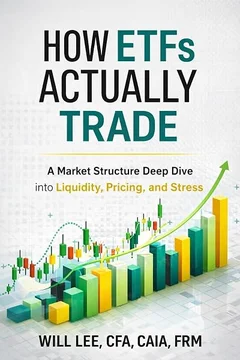
For traders, PMs, and ETF specialists: a practitioner's deep dive into APs, market makers, NAV vs. iNAV, and trading under stress.
Get the ETF trading checklist, plus course updates
A one-page checklist for reviewing an ETF's spread, underlying liquidity, and premium or discount before you trade. You'll also get a note when a new course module is published.
No spam. Unsubscribe anytime.
Disclaimer
This material is provided for informational and educational purposes only and does not constitute investment advice, a recommendation, or an offer to buy or sell any security.
All views expressed are the author’s own and do not represent the views of any employer or affiliated organization.