A CLO ETF is an exchange-traded fund that holds debt tranches of collateralized loan obligations (CLOs), which are securitizations backed by a diversified pool of syndicated leveraged loans and issued in a seniority stack from senior notes down to equity. The fund's shares trade on an exchange throughout the day, while official NAV is typically based on evaluated prices for those tranches, which trade over the counter, so the market price and the NAV can differ.
Covered in: How ETFs Actually Trade (book)
Common questions
- What is a CLO, and what does a CLO ETF hold?
- A collateralized loan obligation, or CLO, is a special-purpose vehicle that holds a diversified pool of leveraged loans—typically syndicated loans to below-investment-grade or unrated businesses—and funds them by issuing securities called tranches. Those tranches form a waterfall: senior notes, which are often AAA-rated, are paid first and absorb losses last; mezzanine and junior notes sit in the middle; and unrated equity is paid last and bears losses first. Investors in the rated debt tranches receive principal and interest; equity receives residual cash flow after fees and the debt payments. Interest on the debt tranches is typically a floating rate, a market reference rate plus a spread, because the underlying leveraged loans themselves typically pay a floating rate. A CLO ETF holds these CLO securities rather than the underlying loans themselves. Illustration: suppose a CLO holds $100 of loans and issues $60 of senior notes, $30 of mezzanine and junior notes, and $10 of equity. If the loan pool takes an $8 principal loss, equity absorbs it, and the debt notes can still be paid in full. If the loss is $12, equity is wiped out and the mezzanine and junior notes bear the remaining $2. Hypothetical figures, for arithmetic only; not a live deal or fund. See also: Fixed income ETF.
- How does a CLO ETF's NAV differ from its market price?
- CLO debt tranches typically trade over the counter, not on an exchange. Trades are bilateral and usually intermediated by dealers, and a given tranche may not trade every day, so there is often no fresh exchange print to mark official NAV. A CLO ETF's NAV is typically built from pricing-service evaluations or dealer quotations for those tranches, rather than from a last exchange trade. The ETF's shares, by contrast, trade throughout the day at a market price. In stressed markets, trading in the tranches can thin out, evaluated prices can lag, and premiums or discounts often widen. In that setting the live ETF price can be the more current signal of where the tranches can actually be traded, and a wide gap is not, by itself, proof that the ETF has failed. Illustration: if official NAV is $100.00 and the midpoint is $99.20, the market price is 80 cents, or 80 basis points, below NAV—an 80 bp discount. Hypothetical figures, for arithmetic only. See also: NAV vs market price · Premium / discount · Fixed income ETF.
- How does a CLO ETF's floating-rate income get paid out, and how are shares created?
- Interest on a CLO ETF's floating-rate holdings generally accrues in the fund's NAV as it is earned. When the reference rate rises or falls, the interest on the debt tranches generally moves with it, plus the fixed spread on each tranche. The fund then pays that income to shareholders on a schedule set in its prospectus; distributions are not guaranteed. As on other ETFs, the NAV typically falls by about the distribution amount on the ex-date, which is a transfer of value to eligible shareholders, not by itself a loss. Illustration: if NAV is $25.00 and the fund pays $0.10 per share, NAV falls to $24.90 on the ex-date, all else equal. Hypothetical figures, for arithmetic only. Authorized participants can create or redeem a CLO ETF in kind, in cash, or with a mix. Because individual CLO tranches trade over the counter and may be hard to deliver as a complete, pro rata basket, the fund may use a custom or representative basket, or a large cash component, rather than a slice of every holding. A cash create or redeem means the fund itself buys or sells tranches; an in-kind trade moves a basket of holdings and may include a cash balancing amount. Buying or selling the ETF in the secondary market does not, by itself, require anyone to trade every underlying tranche, but tradable liquidity still depends on those tranches when creations, redemptions, or hedges need them. See also: ETF distributions · Custom basket · Cash creation and redemption · Underlying liquidity.
Related terms
Go deeper: books by Will Lee, CFA
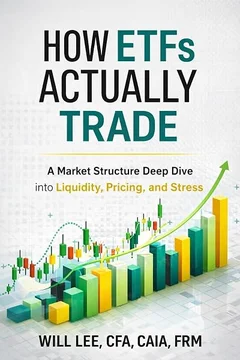
For traders, PMs, and ETF specialists: a practitioner's deep dive into APs, market makers, NAV vs. iNAV, and trading under stress.
Get the ETF trading checklist, plus course updates
A one-page checklist for reviewing an ETF's spread, underlying liquidity, and premium or discount before you trade. You'll also get a note when a new course module is published.
No spam. Unsubscribe anytime.
Disclaimer
This material is provided for informational and educational purposes only and does not constitute investment advice, a recommendation, or an offer to buy or sell any security.
All views expressed are the author’s own and do not represent the views of any employer or affiliated organization.