A private asset ETF is an exchange-traded fund that holds, or has exposure to, private or otherwise hard-to-trade assets—such as private credit—alongside more liquid securities. The liquid portion is typically what market makers and authorized participants use to hedge and to create or redeem shares.
Covered in: How ETFs Actually Trade (book)
Common questions
- How can an ETF hold private assets?
- An open-end ETF that includes private or other hard-to-trade assets typically keeps a liquidity sleeve of more readily traded securities and cash. Authorized participants create and redeem against that sleeve, not by delivering the private holdings themselves. Registered open-end funds, including ETFs, generally may not acquire an illiquid investment if that would put more than 15% of net assets in holdings the fund reasonably expects cannot be sold within seven calendar days without significantly changing their value (SEC Rule 22e-4). The private portion is fair-valued under the fund's valuation procedures, often with more judgment and less frequent market evidence than exchange-traded holdings, so official NAV can lag. Other wrappers, such as interval or closed-end funds, can hold a larger private allocation; they are not the same as a daily create-and-redeem ETF. See also: Underlying liquidity · Why ETF Liquidity Is Not the Same as AUM · Creation and redemption.
- Why can a private credit ETF trade at a premium or discount?
- A private credit ETF's official NAV depends in part on a fair value for loans or other private holdings that do not trade continuously. If that value is stale, or if creations and redemptions can use only the liquid sleeve, authorized participants cannot arbitrage as tightly as they can when the full portfolio is liquid and marked to market. The arbitrage band is therefore often wider, and a premium or a discount can persist. That gap is a market-structure outcome of underlying liquidity and valuation, not by itself proof that the fund has failed. See also: Premium / discount · Arbitrage band · Underlying liquidity.
- What happens to the price when the private assets are hard to value?
- When the private portion is hard to value, the fund's published NAV may not reflect what those holdings would fetch if they had to be sold today. The ETF's market price can then diverge from that NAV, and market makers typically widen their quotes because the hedge and the fair value are both uncertain. A large premium or discount in that setting is information about valuation lag and underlying liquidity, not a precise measure of mispricing. See also: NAV vs market price · Premium / discount · Why ETF Liquidity Is Not the Same as AUM.
Related terms
Go deeper: books by Will Lee, CFA
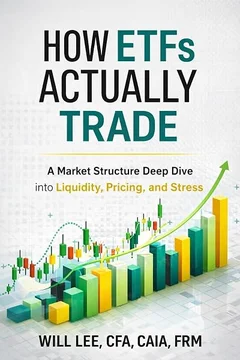
For traders, PMs, and ETF specialists: a practitioner's deep dive into APs, market makers, NAV vs. iNAV, and trading under stress.
Get the ETF trading checklist, plus course updates
A one-page checklist for reviewing an ETF's spread, underlying liquidity, and premium or discount before you trade. You'll also get a note when a new course module is published.
No spam. Unsubscribe anytime.
Disclaimer
This material is provided for informational and educational purposes only and does not constitute investment advice, a recommendation, or an offer to buy or sell any security.
All views expressed are the author’s own and do not represent the views of any employer or affiliated organization.